




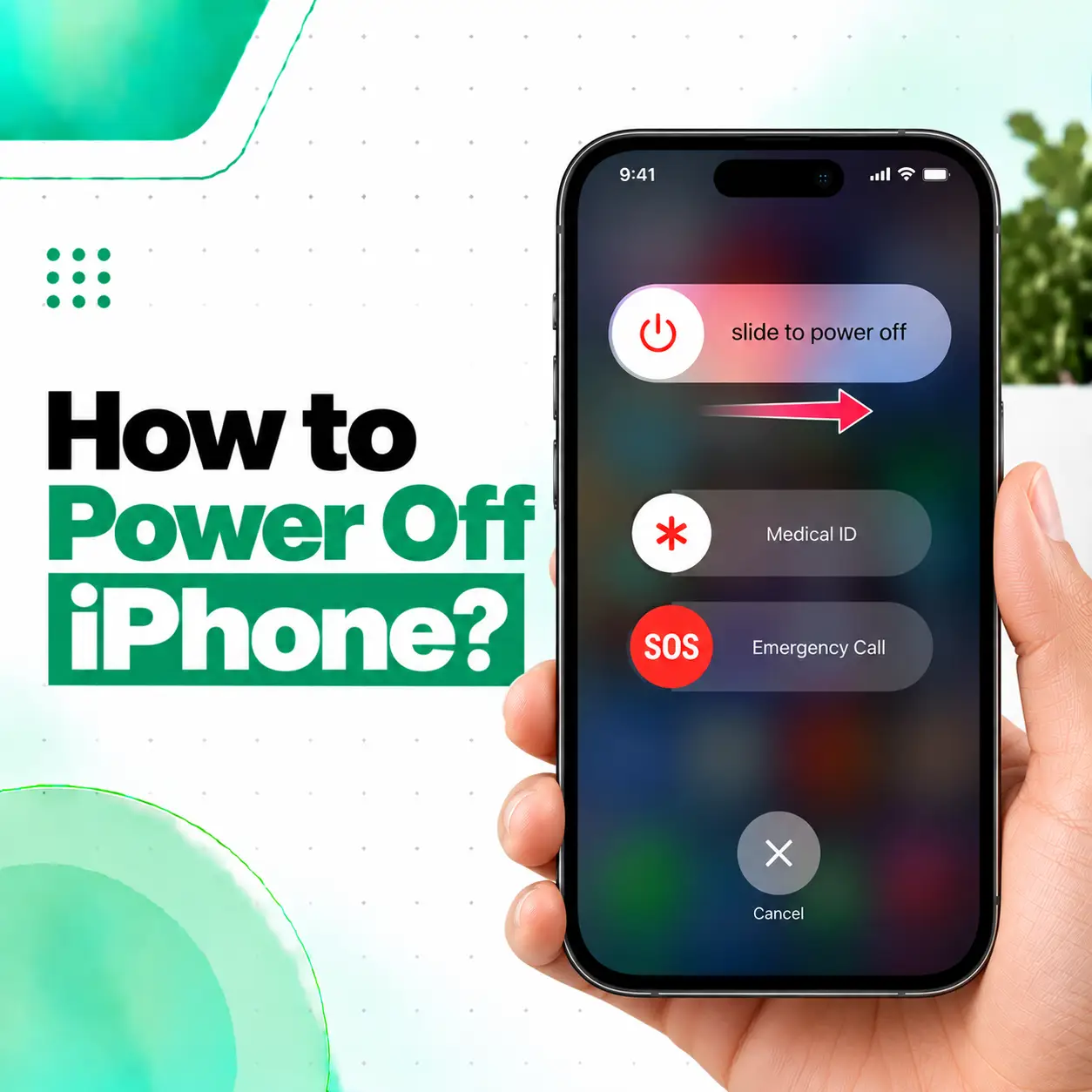
If you need to know how to power off iPhone, the process is simple once you know which method matches your model. On iPhones with Face ID, you normally press and hold the Side button and either Volume button until the Power Off slider appears. On iPhones with a Home button, you generally hold the Side button and then drag the slider. Apple also provides ways to shut down an iPhone through Settings and Control Center, so you don’t always need the physical buttons.
This guide explains the different ways to completely power off an iPhone, how powering off differs from restarting, and what to do if your iPhone is frozen, unresponsive, or has a faulty button.
How Do You Power Off an iPhone?
The quickest method depends on your iPhone’s design.
iPhones With Face ID
Most newer iPhones without a physical Home button use the following method:
- Press and hold the Side button.
- At the same time, press and hold either Volume button.
- Keep holding until the power-off sliders appear.
- Drag the Power Off slider to the right.
- Wait for the iPhone to finish shutting down.
Apple currently lists this method for iPhones with Face ID.
This method applies to many newer models, including the iPhone X series and later Face ID models.
iPhones With a Home Button
If your iPhone has a physical Home button:
- Press and hold the Side button.
- Wait for the Power Off slider to appear.
- Drag the slider to the right.
- Wait for the iPhone to shut down.
Apple lists this method for iPhone 6, 7, 8 and compatible SE models.
Older iPhones With a Top Button
Some older iPhone models, including the iPhone 5 and first-generation iPhone SE, use a Top button instead of a Side button.
For these devices:
- Press and hold the Top button.
- Wait for the Power Off slider.
- Drag the slider.
- Wait for the device to turn off.
Apple documents this method for the iPhone SE (1st generation), iPhone 5 and earlier models.
How to Power Off iPhone Without Using the Buttons
You don’t have to use the physical buttons to shut down your iPhone. Apple provides a shutdown option inside Settings.
Use Settings to Shut Down iPhone
Follow these steps:
- Open Settings.
- Tap General.
- Scroll down.
- Tap Shut Down.
- Drag the Power Off slider.
This is particularly useful if a Side or Volume button is difficult to press or isn’t working correctly.
Use Control Center to Power Off iPhone
On supported iOS versions, you can also shut down the iPhone from Control Center:
- Open Control Center.
- Touch and hold the Power button in the top-right corner.
- Wait for the shutdown slider.
- Drag the slider to turn off the iPhone.
On iPhones with Face ID, Control Center is opened by swiping down from the top-right corner. On iPhones with a Home button, swipe up from the bottom edge.
This is another useful option when you don’t want to rely on the physical buttons.
How to Power Off Different iPhone Models
The basic process can be simplified into this table:
| iPhone type | Normal power-off method |
| iPhone X and later Face ID models | Hold Side + either Volume button |
| iPhone 8 / 7 / 6 | Hold Side button |
| iPhone SE 2nd/3rd generation | Hold Side button |
| iPhone SE 1st generation | Hold Top button |
| iPhone 5 and earlier | Hold Top button |
After the Power Off slider appears, drag it to shut down the device. Apple’s current instructions distinguish between Face ID models, Home-button models and older Top-button models.
What Is the Difference Between Powering Off and Restarting an iPhone?
Powering off means shutting the iPhone down completely. Restarting means turning it off and then turning it back on.
For a normal restart:
- Power off the iPhone.
- Wait for it to shut down completely.
- Wait around 30 seconds.
- Press and hold the Side or Top button until the Apple logo appears.
Apple’s restart instructions specifically advise waiting 30 seconds after dragging the power-off slider before turning the device back on.
A normal restart can be useful when the iPhone is behaving unusually but is still responding normally.
What If Your iPhone Won’t Power Off?
If your iPhone won’t power off, first determine whether the screen is responsive.
If the touchscreen works, try the Settings method:
Settings → General → Shut Down
If the buttons are the problem, this can allow you to shut down the phone without using them.
If the entire iPhone is frozen or doesn’t respond to touch or button presses, a normal shutdown may not work.
If the iPhone Is Frozen or Unresponsive
A force restart may be necessary when the iPhone cannot be shut down normally.
For iPhones with Face ID and other supported newer models:
- Quickly press and release Volume Up.
- Quickly press and release Volume Down.
- Press and hold the Side button.
- Release the Side button when the Apple logo appears.
Apple recommends this procedure when an iPhone isn’t responding and cannot be turned off and back on normally.
Important: A force restart is not the same as a normal power-off. It is a troubleshooting procedure for an unresponsive device.
What If the iPhone Buttons Are Not Working?
If the Side or Volume buttons are faulty but the touchscreen still works, you can usually use Settings → General → Shut Down instead.
You can also use Control Center where the shutdown control is available.
However, a faulty button can be a hardware issue. If the button:
- Doesn’t respond consistently
- Feels loose or stuck
- Requires excessive pressure
- Works intermittently
- Stopped working after a drop
- Became faulty after liquid exposure
then professional inspection may be appropriate.
A technician can determine whether the problem involves the button assembly, internal connection, physical damage or another component.
What If the iPhone Has a Black Screen?
A black screen does not automatically mean the iPhone is permanently damaged.
If the iPhone won’t turn on or the screen remains black, Apple recommends checking whether the device needs charging and, when necessary, performing the appropriate force-restart procedure.
If the device still doesn’t respond after charging and troubleshooting, the problem may require professional diagnosis.
Possible areas that may need inspection include:
- Battery
- Charging system
- Display
- Internal connections
- Software
- Other internal hardware
The exact cause should be determined through diagnosis rather than assuming that a particular component needs replacement.
Should You Power Off Your iPhone Before Repair?
Powering off an iPhone before physical repair is generally appropriate when the device allows a normal shutdown.
Before handing your iPhone to a repair professional, consider:
- Backing up important information if the phone still works.
- Removing charging cables and accessories.
- Explaining any recent drops or liquid exposure.
- Mentioning previous repairs.
- Asking how diagnostic access and personal data will be handled.
If the iPhone is completely unresponsive, don’t repeatedly press buttons in an attempt to shut it down. Follow the appropriate troubleshooting procedure or seek professional assistance.
When Should You Get Professional iPhone Repair?
Simply not knowing how to power off an iPhone does not mean the device needs repair. However, repeated shutdown problems can sometimes indicate a hardware or software issue.
Consider professional inspection if:
- The iPhone repeatedly freezes.
- The Side button doesn’t work.
- The Volume buttons are malfunctioning.
- The touchscreen becomes unresponsive.
- The phone repeatedly shuts down by itself.
- The iPhone won’t turn on after being powered off.
- The screen stays black.
- The device has suffered physical or liquid damage.
- Force restarting doesn’t resolve the problem.
A professional mobile repair service can assess the device and determine whether the issue is related to the software, battery, display, buttons or another internal component.
Does Powering Off an iPhone Delete Your Data?
No. A normal power-off does not erase the information stored on your iPhone.
Your photos, apps, messages and other stored information remain on the device after a normal shutdown.
Powering off is different from erasing all content and settings. You should not confuse the two processes.
If you’re preparing an iPhone for sale or giving it to someone else, a normal shutdown is not enough; a separate data-erasure process is required.
Is It Safe to Power Off an iPhone Regularly?
Yes. Normal shutdown is a standard function of the iPhone.
You don’t need to power off the phone every time you finish using it. However, shutting down or restarting can be useful when troubleshooting certain temporary problems or when the device needs to be completely powered down.
If your iPhone requires frequent restarts because it repeatedly freezes, shuts down unexpectedly or becomes unresponsive, the recurring problem is more important than the shutdown itself.
Frequently Asked Questions
1. How do I power off my iPhone quickly?
On an iPhone with Face ID, press and hold the Side button and either Volume button until the Power Off slider appears, then drag the slider. On many Home-button iPhones, press and hold the Side button and drag the slider.
2. How do I power off an iPhone without using the buttons?
Go to Settings → General → Shut Down, then drag the Power Off slider. You can also use the Power button in Control Center on supported iOS versions. These methods are useful when a physical button is difficult to operate or isn’t working.
3. Is powering off an iPhone the same as restarting it?
No. Powering off completely shuts down the device. Restarting involves shutting it down and then turning it back on. A normal restart can be useful for temporary software issues, while a force restart is intended for situations where the iPhone is frozen or unresponsive.
4. What should I do if my iPhone won’t power off?
If the touchscreen works, try Settings → General → Shut Down. If the iPhone is completely frozen, use the appropriate force-restart procedure for your model. For newer Face ID iPhones, this involves pressing and releasing Volume Up, pressing and releasing Volume Down, then holding the Side button until the Apple logo appears.
5. Can I power off an iPhone if the Side button is broken?
Yes, if the touchscreen is working, you can use Settings → General → Shut Down instead of the physical button. Control Center may also provide a shutdown option. If the button is physically damaged or consistently fails, professional inspection can help identify whether the button assembly or another internal component needs attention.
6. Will powering off my iPhone delete my photos and apps?
No. A normal power-off simply shuts down the device and does not erase your stored data. Photos, apps, messages and other information remain on the iPhone. Data is erased through separate actions, such as the specific erase-all-content process, not through a normal shutdown.
7. Why does my iPhone keep shutting down by itself?
Repeated unexpected shutdowns can have several possible causes, including software problems, battery-related issues or other hardware faults. If the problem continues after normal troubleshooting and restarting, professional diagnosis can help identify the underlying cause instead of simply treating each shutdown as an isolated event.
Conclusion
Knowing how to power off iPhone is straightforward once you identify the method appropriate for your model. Face ID iPhones generally use the Side button + either Volume button, while many Home-button models use the Side button alone. You can also shut down an iPhone through Settings → General → Shut Down or, on supported software, through Control Center.
If your iPhone won’t power off because it is frozen, unresponsive, or has a faulty button, the problem may go beyond the normal shutdown process. A force restart can help with an unresponsive device, but persistent problems should be professionally assessed.
If your iPhone continues to freeze, shut down unexpectedly, or has a damaged Side button or touchscreen, iCareFix can inspect the device and help determine whether the issue is related to software, the battery, display, buttons or another hardware component.