




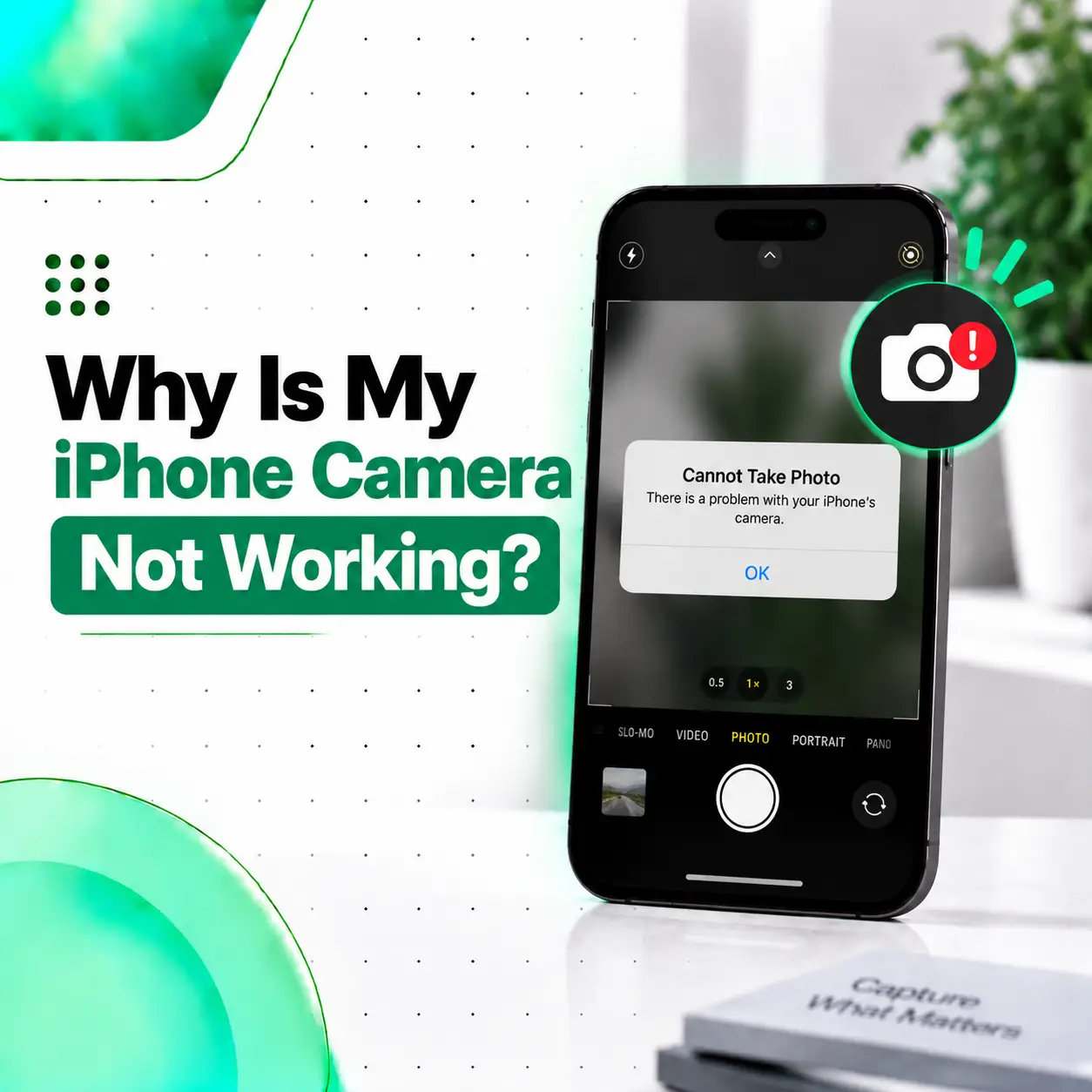
If you are wondering why is my iPhone camera not working, the cause may be something simple such as a blocked lens, case, magnetic accessory, or temporary software problem. It can also indicate a damaged camera module, connector, or other internal hardware issue.
Apple recommends removing accessories that may interfere with the camera, cleaning the lenses with a microfiber cloth, restarting the iPhone, updating iOS, and testing both the front and rear cameras.
This guide explains the most common reasons an iPhone camera stops working, what you can safely check at home, what different symptoms may indicate, and when professional inspection from a phone repair technician such as iCareFix may be appropriate.
Why Is My iPhone Camera Not Working?
An iPhone camera may stop working because of a temporary software issue, blocked or dirty lens, incompatible accessory, magnetic interference, physical damage, liquid exposure, or a problem with the camera hardware or its connection.
The symptoms can help narrow down the likely cause.
For example:
- Black camera screen: The Camera app may be malfunctioning, or there may be a hardware problem.
- Blurry photos: A dirty or damaged lens, focusing problem, or accessory interference may be responsible.
- Camera app freezes: A temporary iOS or app-related issue may be involved.
- Front camera works but rear camera does not: The problem may be isolated to the rear camera system.
- Both cameras fail: Software or a broader hardware issue becomes more likely.
- Camera works but cannot focus: Autofocus or camera hardware may need inspection.
Apple specifically recommends testing whether one or both cameras are affected.
Common Reasons an iPhone Camera Stops Working
1. A Temporary Software Glitch
A temporary iOS or Camera app problem can sometimes prevent the camera from opening or functioning correctly.
You may notice:
- A black screen when opening Camera
- Camera app freezing
- Camera taking a long time to respond
- Camera closing unexpectedly
- Flash behaving unusually
Restarting the iPhone is one of the basic troubleshooting steps recommended by Apple.
2. A Dirty or Obstructed Camera Lens
Fingerprints, dust, or other debris on the lens can make photos appear blurry or hazy.
Before assuming the camera itself is damaged, gently clean the front and rear camera lenses with a clean microfiber cloth. Apple recommends this when photos appear blurry.
Avoid using abrasive materials or applying liquid directly to the camera.
3. Your Case or Accessory May Be Interfering
Some cases, camera attachments, lens protectors, or other accessories can partially block the camera.
Remove the case or accessory temporarily and test the camera again.
This is particularly important if the problem started after installing a new accessory.
4. Magnetic Accessories Can Affect Camera Performance
Some iPhone camera systems use technologies such as optical image stabilization (OIS) and autofocus mechanisms that can be affected by strong magnetic fields.
Apple notes that magnetic accessories or metal plates positioned near the rear camera can interfere with sensors used by OIS and autofocus on supported iPhone models.
If you use a magnetic car mount, magnetic case, or similar accessory, remove it and test the camera.
5. The iPhone May Need an iOS Update
An outdated or malfunctioning software environment can sometimes contribute to camera problems.
Check whether an iOS update is available and install it through Apple’s normal software-update process.
Apple includes updating iOS among its recommended troubleshooting steps for camera problems.
6. Physical Camera Damage
If the iPhone has been dropped, crushed, or otherwise physically damaged, the camera hardware may be affected.
Possible symptoms include:
- Camera suddenly stopped working after a drop
- Persistent black screen
- Camera vibration
- Unusual clicking or rattling
- Severe focusing problems
- Distorted images
- One camera working while another does not
In these situations, software troubleshooting may not resolve the problem.
7. Liquid or Moisture Exposure
Liquid exposure can affect camera components and other internal connections.
If the camera problem appeared after the phone was exposed to water or another liquid, avoid repeatedly testing or opening the device yourself. Professional inspection is safer because liquid-related damage may involve more than the camera module itself.
8. Camera Hardware or Connector Problems
The camera is not simply a piece of glass on the back of the phone. It is part of a hardware system that communicates with the iPhone’s internal electronics.
A problem involving the camera module, connector, flex assembly, or related circuitry can cause persistent camera failure.
This type of issue generally requires diagnosis rather than repeated software resets.
What Should You Check If Your iPhone Camera Is Not Working?
Before taking your iPhone for repair, work through these basic checks.
Step 1: Remove the Case and Accessories
Take off:
- Phone case
- Camera lens accessories
- Magnetic mounts
- Magnetic cases
- Metal camera attachments
Then open the Camera app and test it again.
Apple specifically recommends removing cases, films, and accessories that may obstruct the camera or place magnets near it.
Step 2: Clean the Camera Lens
Use a soft microfiber cloth to gently clean the front and rear camera lenses.
Do not use rough fabric or abrasive materials.
Step 3: Test the Front and Rear Cameras
Open the Camera app and switch between the available cameras.
Check:
- Front camera
- Main rear camera
- Other rear camera options, where available
- Photo mode
- Video mode
This helps determine whether the issue affects one camera or the camera system more broadly.
Step 4: Test the Flashlight
Open Control Center and test the flashlight.
The iPhone’s LED flash also functions as a flashlight, so this can provide another useful symptom when diagnosing a camera/flash problem.
A flashlight problem does not by itself prove that the camera is damaged, but it can be useful information for a technician.
Step 5: Restart the iPhone
Restart the device and test the camera again.
A restart can resolve temporary software problems without changing your personal data.
Step 6: Update iOS
Check for an available iOS update and install it if appropriate.
After updating, open Camera and test the affected camera again.
How Do You Know If the iPhone Camera Has a Hardware Problem?
A hardware issue becomes more likely when the camera continues failing after basic troubleshooting, particularly when the problem began after physical or liquid damage.
Look for signs such as:
- Persistent black camera screen
- Camera failure after a drop
- Camera vibration
- Unusual mechanical noise
- Severe focus failure
- Camera works intermittently
- One camera consistently fails while another works
- Visible camera or lens damage
- Camera failure after liquid exposure
If the camera continues to malfunction after removing accessories, cleaning the lens, restarting, and updating iOS, Apple recommends seeking service.
How Is an iPhone Camera Problem Diagnosed?
Professional diagnosis should begin with identifying what exactly is failing, rather than immediately replacing a component.
Visual Inspection
A technician can check the device for:
- Cracked camera glass
- External impact
- Signs of liquid exposure
- Damaged camera components
- Misaligned or obstructed lenses
Software and Function Testing
The technician can test whether:
- The Camera app opens
- The front camera works
- The rear camera works
- Video recording works
- Flash functionality works
- Autofocus behaves normally
Hardware Inspection
If software troubleshooting does not resolve the problem, the camera module and its connections may need further inspection.
Depending on the model and symptoms, the issue could involve the camera assembly, connector, flex connection, or other internal circuitry.
Can an iPhone Camera Be Repaired?
Yes, some iPhone camera problems can be repaired, but the appropriate solution depends on the actual cause.
Possible repair approaches include:
- Cleaning or removing an obstruction
- Removing an interfering accessory
- Replacing a damaged camera component
- Repairing a damaged connection
- Addressing related internal hardware problems
Not every camera failure requires the same repair. A technician should diagnose the device before recommending replacement or component-level repair.
How Much Does iPhone Camera Repair Cost in Bangladesh?
There is no single price for every iPhone camera repair.
The final repair cost can depend on:
| Cost Factor | Why It Matters |
| iPhone model | Different models use different camera systems |
| Damaged component | A camera module and connector issue are different repairs |
| Damage severity | More extensive damage can require additional work |
| Part availability | Some replacement parts may be easier to source than others |
| Part quality | Repair options can vary by component quality and compatibility |
| Labor | More complex repairs can require additional technician time |
| Additional damage | Liquid or impact damage may affect other components |
For this reason, it is better to have the iPhone diagnosed before agreeing to a repair price.
If you are comparing phone repair services in Bangladesh, ask what component is being replaced or repaired, what type of part will be used, and whether any repair warranty is provided.
Should You Replace the iPhone or Repair the Camera?
Repair may make sense when the rest of the iPhone is functioning normally and the camera problem is isolated.
Consider:
- Age and condition of the iPhone
- Overall device performance
- Camera damage
- Repair cost
- Availability of suitable replacement parts
- Condition of the battery and display
- Whether other major components are damaged
A professional diagnosis can help you compare the likely repair cost with the condition and value of the device.
Can You Fix an iPhone Camera Yourself?
You can safely try basic troubleshooting such as removing accessories, cleaning the lens, restarting the iPhone, updating iOS, and testing the front and rear cameras.
However, opening an iPhone to replace a camera or investigate internal connections is a different matter.
DIY internal repair can create additional risks, particularly if you do not have the appropriate tools or repair experience. If the phone has physical or liquid damage, professional inspection is generally the safer approach.
What Should You Do If the iPhone Camera Shows a Black Screen?
If your iPhone camera shows a black screen:
- Close and reopen the Camera app.
- Remove the phone case and camera accessories.
- Remove magnetic accessories.
- Clean the camera lens.
- Switch between front and rear cameras.
- Restart the iPhone.
- Update iOS.
- Test the camera again.
If the screen remains black after these steps, the device may require professional diagnosis. Apple lists a black camera screen among the symptoms for which these troubleshooting steps can be appropriate, followed by service if the issue persists.
When Should You Take Your iPhone for Professional Repair?
Professional inspection is appropriate when:
- The camera remains completely black.
- The camera stopped working after a drop.
- The camera stopped working after liquid exposure.
- Autofocus no longer works properly.
- The camera shakes or vibrates abnormally.
- The lens or camera glass is physically damaged.
- Only one camera consistently fails.
- The problem returns after restarting.
- Basic troubleshooting does not solve the issue.
A persistent camera problem can sometimes be caused by hardware rather than the Camera app, so repeatedly resetting the device may not solve it.
How to Prevent Future iPhone Camera Problems
You can reduce avoidable camera problems by:
- Keeping the camera lenses clean.
- Using compatible cases and accessories.
- Avoiding strong magnets close to the rear camera.
- Protecting the phone from drops and impacts.
- Keeping iOS updated.
- Avoiding unnecessary exposure to water or other liquids.
- Having unusual camera behavior checked before the problem becomes worse.
Apple specifically advises avoiding accessories with magnets or magnetic metal near supported iPhone rear cameras because they can interfere with camera sensors.
Frequently Asked Questions
1. Why is my iPhone camera not working but the flashlight works?
If the flashlight works but the Camera app does not, the issue may be limited to the camera system or software rather than the LED flash. Try removing accessories, restarting the iPhone, updating iOS, and testing both cameras. If the camera remains unusable, professional diagnosis can determine whether the camera hardware or its connection is involved.
2. Why is my iPhone camera showing a black screen?
A black camera screen can result from a temporary software problem, accessory interference, or a hardware issue. Remove the case and magnetic accessories, restart the iPhone, update iOS, and test the front and rear cameras. If the screen remains black, the device may need professional service.
3. Why is my iPhone camera blurry even after cleaning the lens?
Persistent blur after cleaning may indicate a focusing problem, damaged lens or camera component, or interference from an accessory. Magnetic accessories can affect camera stabilization and autofocus mechanisms on supported iPhone models. Remove such accessories and test again.
4. Can an iPhone camera be repaired instead of replaced?
It depends on the cause of the failure. Some problems may involve an accessory or software issue, while others may require a camera-component replacement or repair of a related connection. A technician should diagnose the device first rather than assuming that the entire camera needs replacement.
5. How much does iPhone camera repair cost in Bangladesh?
There is no universal price because the cost depends on the iPhone model, damaged component, part availability, part quality, labor, and severity of the damage. A professional inspection can identify the required repair and provide a more accurate cost estimate.
6. Is it safe to repair an iPhone camera myself?
Basic troubleshooting such as cleaning the lens, removing accessories, restarting the phone, and updating iOS is generally appropriate for users. Internal camera repair is different and requires suitable tools and technical knowledge. Attempting internal repairs without the proper experience can cause additional damage.
7. When should I take my iPhone to a repair shop for a camera problem?
Consider professional inspection if the camera remains unusable after basic troubleshooting, or if the problem began after a drop, impact, or liquid exposure. Persistent black screens, abnormal camera movement, severe focus problems, or failure of one camera can also justify professional diagnosis.
Conclusion
If you are asking why is my iPhone camera not working, start with the simplest possibilities: remove cases and magnetic accessories, clean the lens, restart the iPhone, update iOS, and test both the front and rear cameras. These steps address several common causes and are consistent with Apple’s troubleshooting guidance.
If the camera still does not work, especially after physical or liquid damage, the problem may require hardware diagnosis. Avoid assuming that a complete camera replacement is necessary until the device has been properly inspected.
If your iPhone is still experiencing the problem, iCareFix Phone Repair can assess the device and help determine whether the issue is related to the camera component, connection, software, or another internal part. A proper diagnosis is the best starting point for choosing an appropriate repair option.